
As I sit here in 2026, the glow of a Meta Quest Pro 3's lenses still fresh in my memory, my mind drifts back to the crucible of innovation that was 2022. It was a year when virtual reality, no longer a fledgling novelty, began to flex its muscles in earnest, and the stage for this awakening was The Game Awards. I remember the palpable tension, not between the titans like Elden Ring and God of War, but in the quieter, more intimate arena of VR/AR. This was a battle not of scale, but of soul, where five distinct worlds vied to define the future of immersion. For me, that year wasn't about predicting a winner; it was about witnessing a tapestry of ambition being woven, thread by shimmering thread.
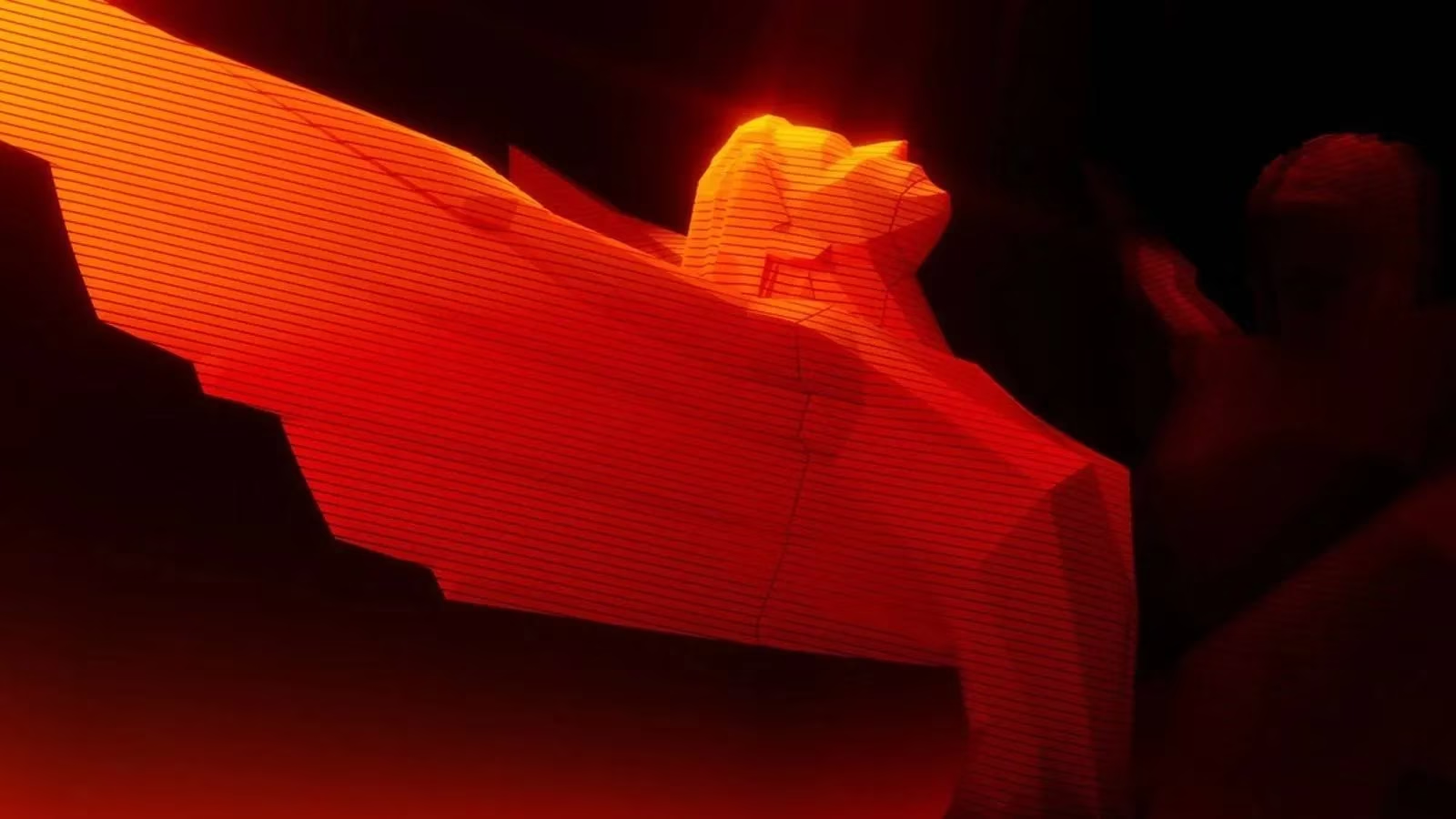
My journey began in the frozen, collaborative hellscape of After the Fall. Stepping into that world was like entering a snow globe shaken by a furious god. The crunch of snow underfoot, the frantic communication with three other souls—it captured the visceral, heart-pounding camaraderie of classic co-op shooters. The developers, veterans from Arizona Sunshine, aimed for a gritty realism. Yet, for all its solid core and fluid combat, the experience began to feel like a beautifully rendered but repetitive sonata. The environments, though initially stunning, soon echoed with a familiar chill, and the zombie hordes, while terrifying, lacked the variety to sustain long-term fear. It was a powerful proof of concept for social VR, but one that felt, at times, like a magnificent ice sculpture—impressive to behold, yet destined to melt into a pool of familiar shapes.
Then came the social experiment of Among Us VR. Its arrival was less of a launch and more of a cultural meteor strike. Translating the deceitful party game into VR was a masterstroke. The experience of standing in the cramped corridors of the Skeld, hearing a crewmate's voice grow fainter as they walked away, then suddenly cut off—it transformed paranoia into a physical sensation. Proximity chat wasn't just a feature; it was the entire nervous system of the game. It birthed viral moments that spread across the internet like digital wildfire. Playing it felt like being a neuron in a vast, chattering, and deeply suspicious brain. Its brand recognition was a towering lighthouse, impossible to ignore. Yet, beneath the social frenzy, the gameplay itself was elegantly simple. It was a perfect vessel for human interaction, but the vessel itself, I pondered, was perhaps not as intricately carved as others in the race.
Ah, Bonelab. This was the wildcard, the ambitious physicist of the group. Following the revolutionary Boneworks, it promised to push the boundaries of virtual physics to their breaking point. And push it did. Interacting with its world was unlike anything else; every object had weight, every collision a consequence. It was a sandbox of potential, a playground for the laws of virtual physics. Yet, striving for such lofty ambition made it stumble. The campaign felt like an afterthought, a series of obstacles designed to showcase the engine rather than to tell a compelling tale. The climbing could be as frustrating as trying to scale a cliff made of wet soap, and a plague of bugs at launch made the experience feel unpolished. It was a brilliant, chaotic laboratory, but not always a fun place to live. Its potential shimmered like a mirage—undeniable from a distance, but dissolving into frustration upon closer inspection.
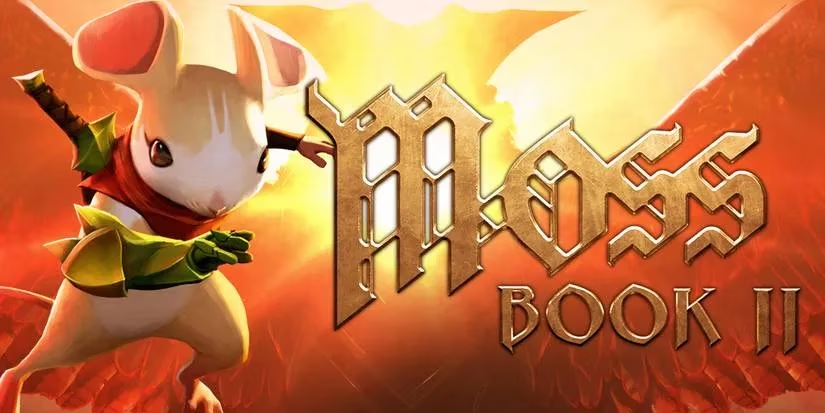
In stark contrast stood Moss: Book 2. This was my personal sanctuary in the VR landscape. Returning to the story of Quill, the brave little mouse, felt like opening a cherished, illuminated storybook where I wasn't just a reader, but the guardian spirit hovering over the pages. The leap from the first game was profound. It evolved from a linear tale into a charming, Metroidvania-lite world full of secrets to uncover. The bond with Quill deepened; my interventions as the silent "Reader" felt more purposeful, manipulating the diorama-like environments to create paths and solve puzzles. Yes, its PSVR roots sometimes showed in its visual fidelity, like a lovingly hand-drawn animation playing next to a photorealistic render. But what it lacked in raw power, it made up for in heart, cohesion, and sheer joy. It was the most complete experience—a perfectly crafted music box in a room full of booming speakers.
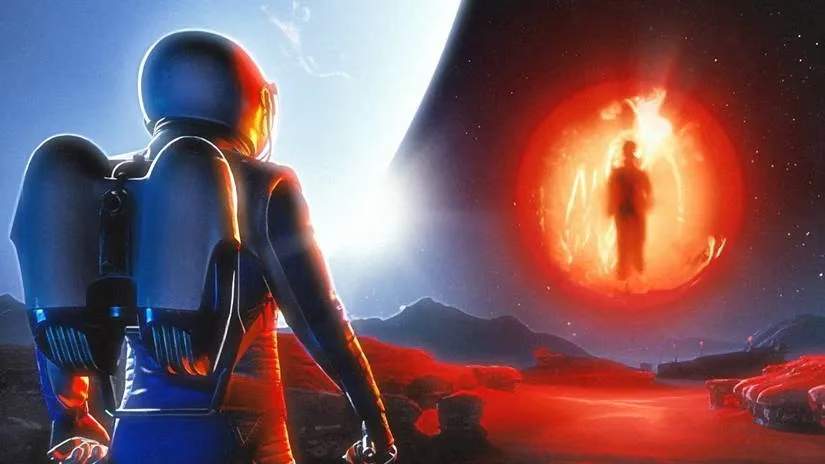
And then, there was the technical marvel: Red Matter 2. This game was a statement. It declared that the standalone Quest 2 was capable of hosting worlds of breathtaking beauty. Its dystopian, Cold War-in-space aesthetic was rendered with a clarity that felt illicit. Every surface, every beam of light in its sterile yet haunting environments, was a testament to optimization genius. Playing it was like exploring a ghost ship made entirely of polished obsidian and frozen light. The puzzles were satisfying, the story weighty, but it was the sheer technical achievement that left one in awe. It was less a game and more a benchmark, a vision of the future worn on your face.
So, who would win? As the ceremony approached, the community buzzed. The contenders had laid bare the multifaceted soul of VR:
| Contender | Core Strength | Primary Weakness | Vibe |
|---|---|---|---|
| After the Fall | Co-op Intensity & Gameplay Fluidity | Lack of Content Variety | Frantic Winter Symphony 🎻 |
| Among Us VR | Social Phenomenon & Proximity Chat | Relatively Simple Gameplay Core | Viral Suspicion Party 🎭 |
| Bonelab | Groundbreaking Physics Sandbox | Buggy & Unpolished Execution | Chaotic Invention Lab 🔧 |
| Moss: Book 2 | Heartfelt Story, Complete Package | Slightly Dated Visuals (PSVR) | Enchanting Storybook 🏮 |
| Red Matter 2 | Technical Masterpiece & Visuals | Less Innovative Core Gameplay | Polished Obsidian Monument 💎 |
In the end, the crown went to Moss: Book 2. Looking back from 2026, I understand why. It wasn't the loudest, the most technically stunning, or the most viral. It was the one that mastered the alchemy of VR: it seamlessly blended player agency (as the Reader) with a character you cared for (Quill), wrapped it in a world that begged to be explored, and delivered it all with impeccable polish. It proved that in a realm of infinite possibility, sometimes the most powerful magic is found in a focused, heartfelt journey. That little mouse and her book didn't just win an award; they etched a permanent, gentle smile onto the face of virtual reality itself. The other contenders were flashes of lightning, but Moss: Book 2 was the steady, warm candle by which we read the future.