
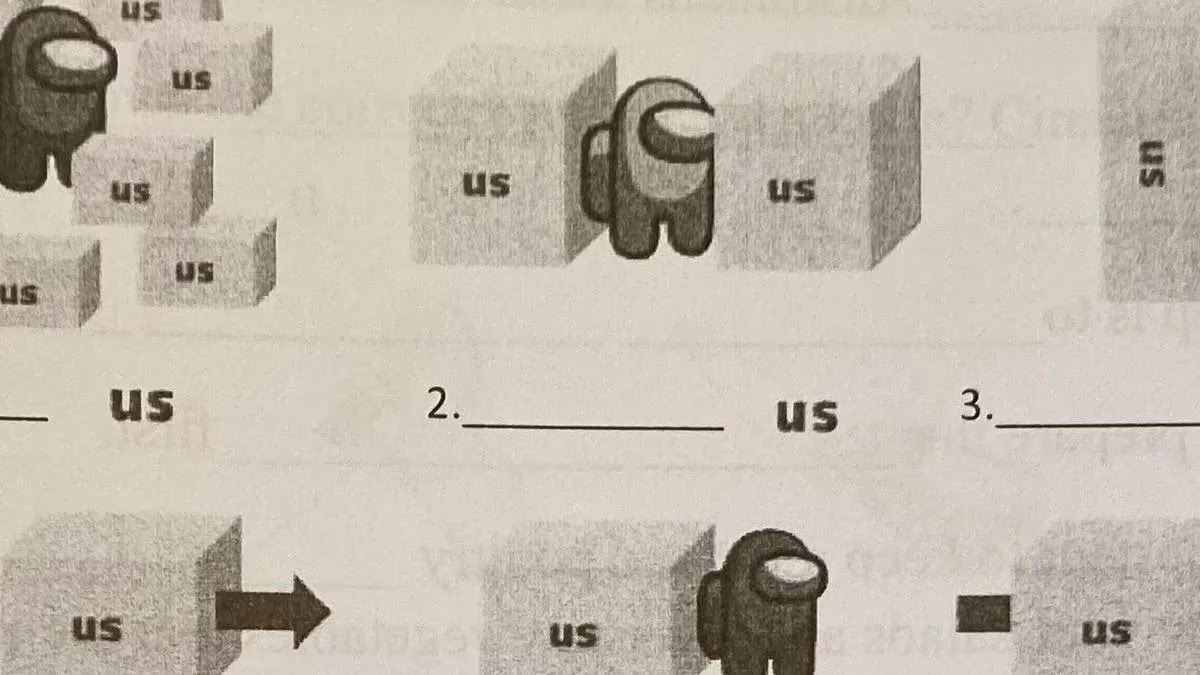
The unmistakable bean-shaped astronauts of Among Us have materialized in a classroom English assignment, demonstrating how a social deduction game can become a small but telling part of educational culture. Posted by Reddit user RealMrOoof, the worksheet asks students to fill in blanks using prepositions while crewmates illustrate spatial relationships through their positions. What once looked like a fleeting internet joke now reads like a fossilized snapshot of how deeply games can embed themselves in daily life.
In the assignment, learners complete statements about where a crewmate is standing, such as 'The crewmate is ___ the boxes' or 'There is an Impostor ___ the group.' The first blank reportedly calls for the phrase 'Among Us,' cleverly turning the game’s title into a grammatical example. This is not merely a gimmick; it is a targeted use of familiar imagery to anchor abstract rules of language.
From Streaming Breakout to Classroom Material
The game originally launched in 2018, but its cultural gravity did not fully arrive until Twitch streamers embraced it in 2020. Over the following months, the game pulled language into its orbit like a linguistic lodestone. Words such as 'sus' moved from private voice chats into classrooms, locker rooms, and even news headlines. The crewmate shape—an armless, egg-like astronaut with a visor—became a neon hieroglyph that no longer needs explanation in many online spaces. By 2026, that visual status has only hardened: Among Us iconography shows up in school posters, cafeteria conversations, and cross-generational references, often without any need to mention the game by name.
-
🎮 Original release: 2018
-
📈 Viral explosion: 2020 through Twitch streamers
-
💬 Cultural footprint: 'sus' entering daily speech
-
📚 Classroom use: preposition worksheets featuring crewmates
The Assignment as a Pedagogical Trojan Horse
The worksheet functions as a pedagogical Trojan horse, smuggling grammar practice inside imagery that students already enjoy. Instead of presenting prepositions through generic textbook diagrams, the assignment uses crewmates and the possible Impostor to show location words such as above, below, beside, between, and among. The humor of suspicious characters makes the task feel less like assessment and more like play. Whether the worksheet was truly distributed by a teacher or simply designed as a meme, its method remains effective. Familiar characters lower the cognitive friction of learning abstract grammar, and students may recall the lesson more vividly because it arrived in the costume of a game they already value.
How Games Recontextualize Everyday Words
Among Us is not the first game to reshape ordinary vocabulary. The table below shows a few notable examples:
| Game | Word or phrase absorbed into wider culture |
|---|---|
| Among Us | 'sus,' 'impostor,' and preposition-based spatial language |
| Undertale | 'determination' |
| Danganronpa | 'hope' and 'despair' |
Each of these examples shows that games do more than entertain; they bend language, reinforce repeated phrases, and sometimes give old words a new emotional charge. Among Us is unique, however, because its title itself becomes part of a grammar lesson. The two words 'among' and 'us' are no longer just a preposition and a pronoun. They now arrive preloaded with memories of emergency meetings, alibis, and ejected crewmates.
Why Familiar Characters Make Lessons Stick
Educational research has long suggested that relevance can improve memory. When learners recognize an image, their existing emotional connection can act as an anchor for new information. The Among Us worksheet uses this principle without turning the classroom into a gaming lounge. The game characters are not the lesson; they are the wrapping around the lesson. Students still practice grammar, but they do so through examples that feel native to their world.
The continued presence of Among Us in education also mirrors broader changes in how digital culture influences instruction. Memes, game references, and streaming vocabulary now enter school materials more quickly than in previous decades. A popular character can move from a mobile game to a math problem, an art prompt, or a language exercise in the time it takes for a trend to mature. In some cases, these materials are created by teachers who are themselves players or viewers. In other cases, they are shared as jokes that later become real teaching tools.
Looking Ahead
As of 2026, Among Us remains a recognizable cultural landmark. Expansions into virtual reality and additional crewmate roles have kept the game visible, but its classroom cameo remains one of the most memorable examples of its reach. The assignment may be simple, but it captures something larger: the line between entertainment and education has become porous. When a bean-shaped astronaut can teach prepositions more memorably than a textbook diagram, it is clear that games have become more than a pastime. They have become part of the language through which a generation learns.
This overview is based on Entertainment Software Association (ESA) perspectives on how games intersect with everyday life and learning, helping explain why recognizable icons like Among Us crewmates can meaningfully support classroom grammar practice. By framing prepositions through familiar pop-culture imagery, the worksheet reflects a broader pattern of games becoming part of mainstream literacy—where students bring shared digital references into formal education, making abstract language rules feel more immediate and memorable.