
During a seven-day window in 2021, Epic Games Store users claimed Among Us more than 15 million times, developer InnerSloth revealed. The giveaway ran from May 27 to June 3 as part of Epic's Mega Sale, a four-week promotion that offered a new free title each week. NBA 2K21 opened the event, Among Us followed, and Frostpunk and Remedy's Control closed it out. For a game that had already become a pandemic-era phenomenon, the Epic giveaway was not merely another sale. It was a depth charge dropped into the quiet pond of PC storefront promotions: the splash was temporary, but the pressure wave reached every corner of the game's player base.
The numbers were remarkable even by Epic's standards. Epic Games Store giveaways have historically boosted games both large and small. Football Manager 2020, for example, gained one million users after only three days as a freebie in 2020. Court documents from the Apple v. Epic trial later showed how much such promotions could cost: Epic paid Unknown Worlds $1.4 million for Subnautica's giveaway and Devolver Digital $300,000 for Stories Untold. Among Us, however, did not need a courtroom leak to prove its value. InnerSloth's social media post celebrated 15-plus million downloads, a total that dwarfed many full-price launches and turned the game's Epic debut into a landmark moment.
| Epic Mega Sale free game | Approximate window |
|---|---|
| NBA 2K21 | First week |
| Among Us | May 27 - June 3 |
| Frostpunk | Later week |
| Control | Final week |
🎮 The immediate effect was a sharp increase in Among Us's PC player count. The game was already available on Nintendo Switch, PC via Steam and the Epic Games Store, and mobile platforms, but the giveaway widened its reach on PC in a way that a standard discount might not have. For InnerSloth, the free week became a kind of coral reef for the game's population—temporary scaffolding that left behind durable growth. New players who claimed the game at no cost could sample its social deduction loop, then invite friends, stream matches, or buy cosmetic content later. In a live-service era, that kind of acquisition is often worth more than the sticker price.
The promotion also arrived during a busy period for Among Us. Mediatonic announced a second Among Us crossover for Fall Guys: Ultimate Knockout, which went live on Friday, July 2, 2021. The event gave Fall Guys players a chance to grab a purple impostor skin, complete with a cracked spacesuit visor and gnarly teeth. The crossover reinforced how thoroughly Among Us had embedded itself in the broader multiplayer culture. It was no longer just a game; it was a shared language of sus, tasks, and emergency meetings.
Epic's Mega Sale functioned as a Trojan horse built from zero-dollar price tags, smuggling millions of new crewmates into the game's ecosystem. But the strategy was not unique to Among Us. Epic has repeatedly used free giveaways to convert curiosity into long-term engagement, and developers have learned that a well-timed promotion can reset a title's trajectory. Among Us benefited from a rare alignment: a low price point, a highly shareable social loop, and a storefront audience hungry for multiplayer experiences. The combination produced a claim rate that few games can match.
Looking back from 2026, the Epic giveaway stands as a case study in platform-driven discovery. Among Us eventually moved beyond its initial PC and mobile homes, with console versions arriving on PlayStation and Xbox in late 2021. The game's cultural footprint has since expanded through crossovers, updates, and a persistent community that keeps returning to its skeld-shaped maps. Yet the 15 million Epic claims remain a striking data point: a reminder that a single week of free access can act as a rocket booster for a game already in orbit. For InnerSloth, it was proof that Among Us's appeal was not a fleeting accident of timing, but a durable social engine.
The episode also highlighted the changing economics of PC storefronts. Free games are not charity; they are acquisition tools, audience builders, and bargaining chips. Epic's willingness to pay developers for giveaways, as revealed in court, shows how fiercely platforms compete for user attention. Among Us, with its massive mainstream recognition and low barrier to entry, was an ideal partner. The result was a mutually beneficial arrangement: Epic gained millions of engaged users, and InnerSloth gained millions of new crewmates.
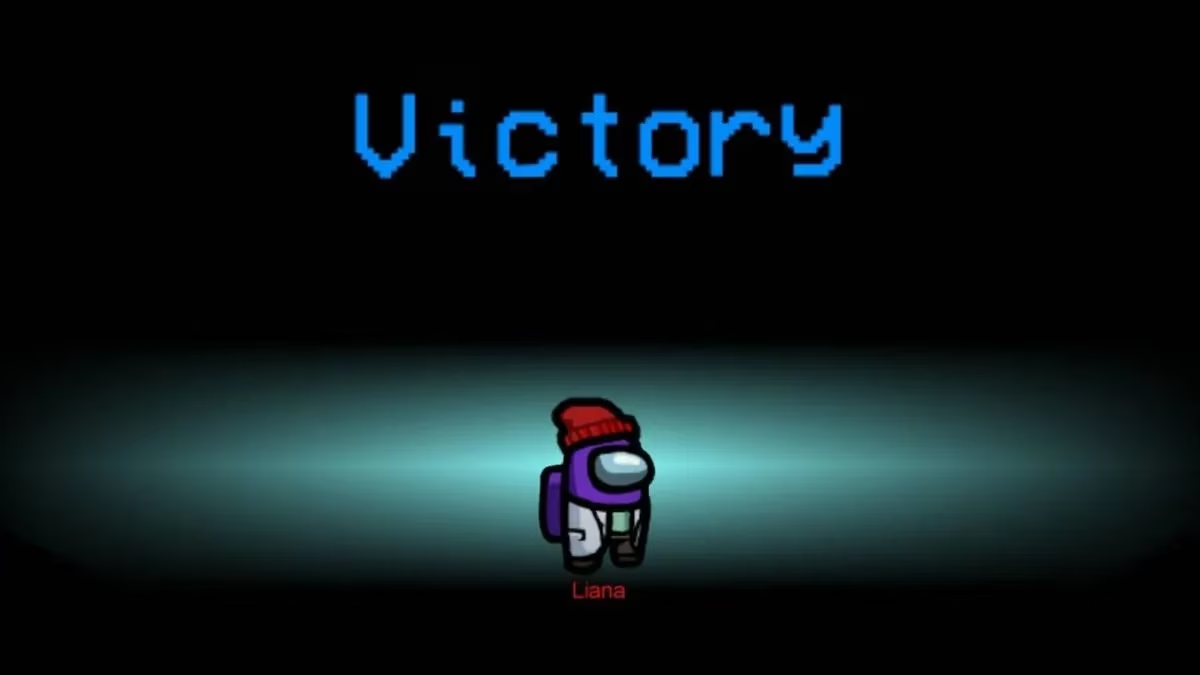
In the end, the 15 million downloads tell a simple story with an uncommon shape. A free giveaway, brief as a meteor shower, left behind a permanent mark on Among Us's PC population. It was a victory screen not just for players, but for a developer that turned a small social deduction game into a global multiplayer institution.