
I still remember the icy thrill that shot down my spine in early 2023 when I finally slipped the VR headset over my eyes and found myself standing inside the Skeld. The leak on SteamDB had been right after all—December 13, 2022, had been the real launch date, and by the time I got my hands on it, the servers were already buzzing with panicked crewmates and cackling impostors. What had once been a flat, cartoonish whodunit on my phone screen was now a fully three-dimensional labyrinth, and I felt like I had stepped out of a blueprint and into a living, breathing spaceship. The shift was as disorienting as going from reading a recipe to actually baking a soufflé in a hurricane; every familiar task mutated into something tangible, demanding, and terrifyingly intimate.
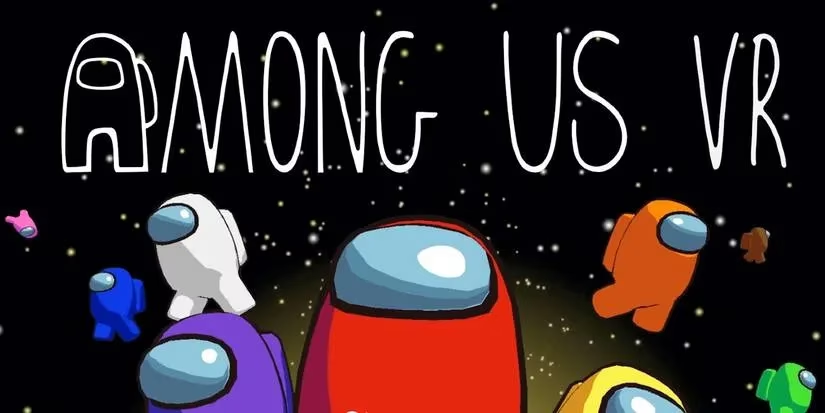
My first memory is of the wires task. In the original game, I used to drag colored lines across a panel with the detached boredom of a data entry clerk. Now, I had to physically grab floating, sparking cables with my virtual hands and guide them into matching ports while sweating under my headset. My fingers fumbled as if I were a clumsy astronaut trying to repair a satellite with oven mitts. Around me, players’ voices echoed in real time, their accusations bouncing off the metal walls. The proximity chat feature had transformed the social deduction into something raw and unnerving; it was no longer text bubbles and canned sounds, but genuine, quavering human voices. When a crewmate’s scream was abruptly cut off two rooms away, my heart lurched like a startled fish yanked by a line. The level of presence made every lie feel like a high-wire act without a net.
The first few months were a glorious mess. Schell Games had clearly taken the extra time to polish the VR translation, and the community exploded with fresh theories and memes. I remember the Meta Quest Gaming Showcase in April 2022 had teased us with a glimpse, but the final product added layers we never expected—like tasks that forced you to crane your neck into ventilation shafts or realign gravity panels while the ship tilted, making you physically dizzy. The shapeshifting impostor, which had just been introduced to the flat version, became a nightmare in VR. One second you’d be chatting with a lime-green bean in the cafeteria, and the next, that same adorable figure would melt and reform into something monstrous right before your eyes, like a wax sculpture collapsing under a blowtorch. I learned quickly to trust no one, not even my own dilated pupils.
Over the years, Among Us VR has continued to weave itself into my gaming routine. Even in 2026, when so many other VR titles have faded, its social dynamics keep me returning. New maps like the Polus surface and the airship have been added, each with unique physical challenges. Now I can chase suspects through howling blizzards or dangle from ladders while a meeting is called. The game studio has even introduced a spectator mode where ghosts can mess with environmental objects to help (or hinder) the living, which has sparked endless mischief. What makes it stick is the way it turns casual deceit into a full-body experience. Looking another player in their glowing visor and lying feels exponentially heavier than tapping a screen; the acting is no longer just a mental game but a performance that demands control over your own posture and voice. It’s like playing poker while standing naked under a spotlight—every twitch could be your undoing.
Reflecting on that initial leak on SteamDB now feels quaint. Back then, we were starving for any release date, scrutinizing database entries and show schedules like oracles reading tea leaves. The journey from a 2D social experiment to a VR staple taught me that immersion isn’t just about graphics; it’s about turning a deductive dance into a physical, breathless ballet. And even after hundreds of hours, the moment the emergency alarm blares and a tiny hand points in my direction, I still feel that ancient, primal jolt of fear—the fear of being caught not just in a lie, but in a whole body that betrayed me.