
As a player who craves deep narratives and meaningful choices over fast-paced action, I've always been drawn to Telltale Games' unique approach. In an industry often focused on graphics and mechanics, they carved out a special place by treating video games like interactive television seasons, where my decisions shaped the story. Their episodic adventures, often based on beloved franchises, offered a different kind of immersion—one of emotional investment and consequence. While the studio's journey has had its ups and downs, revisiting their catalog is like flipping through a photo album of some of my most memorable gaming experiences, where the stories stuck with me long after the credits rolled. Here's my personal take on their standout titles, from the foundational experiments to the narrative masterpieces.
10. Back To The Future
Kicking off my list is a title that feels like a charming, if slightly awkward, first step. Back To The Future holds a nostalgic place in my heart, but it's clear Telltale was still refining its 'choose your own adventure' formula with licensed properties. The mechanics felt a bit clunky compared to their later work. Yet, I can't deny the joy of returning to Hill Valley. Exploring the 1930s—an era the movies never visited—and expanding the lore around Doc Brown and Marty was a genuine treat for a fan. It was a proof of concept, showing that interactive storytelling within established worlds had immense potential, even if the execution wasn't yet perfect.
9. The Walking Dead: Michonne
This one always felt like a compelling, yet compact, side story. A spin-off of a spin-off! The Walking Dead: Michonne focused on filling in the gaps of the fan-favorite character's absence from the comics. As a player, it was a tense, focused experience that delved into her trauma and resilience. It didn't overstay its welcome; it was a sharp, three-episode character study that served as a perfect companion piece to the larger series. While it didn't revolutionize the formula, it delivered exactly what it promised: more time in a brutal world with a compelling protagonist.
8. Game Of Thrones
Oh, this one had so much potential. On paper, a Telltale game set in Westeros is a dream come true. I loved the idea of focusing on House Forrester, a minor family navigating the bloody politics of the War of the Five Kings. For a while, it worked! Scheming in King's Landing or surviving in the North captured the show's spirit. But the translation of Game of Thrones' core—relentless tragedy and betrayal—into a game where I grew attached to my characters created a unique frustration. No matter how clever my choices, the sense of inevitable doom sometimes felt less like compelling drama and more like punishment. Still, merely walking the halls of the Red Keep or the icy paths of the North was an atmospheric thrill.
7. Minecraft: Story Mode
Now, this was a bold and surprisingly successful experiment. Giving a narrative to the ultimate sandbox game? It shouldn't have worked, but it did. Minecraft: Story Mode was clearly geared toward a younger audience, and that's its strength. It captured the blocky, creative, and adventurous spirit of Minecraft while introducing a fun, Saturday-morning-cartoon plot about the Order of the Stone. For me, it was a delightful change of pace—lighter, more humorous, and full of the wonder that makes Minecraft so special. It proved Telltale's formula could be flexible enough to fit even the most open-ended of worlds.
6. Guardians Of The Galaxy
This game had the tough job of standing apart from the mega-popular MCU films, and I think it succeeded brilliantly. Killing Thanos in the first episode was a masterstroke—it immediately signaled this was its own story. What followed was a hilarious, heartfelt, and perfectly structured space opera. Each episode effectively spotlighted a different Guardian, allowing me to connect with Star-Lord's leadership struggles, Rocket's bitterness, or Groot's... well, being Groot. The banter was top-notch, and the original story, involving a mysterious artifact and a cult, felt perfectly suited for this ragtag team. It's a vibrant, pulpy adventure that any fan of the characters should experience.
5. Tales From The Borderlands
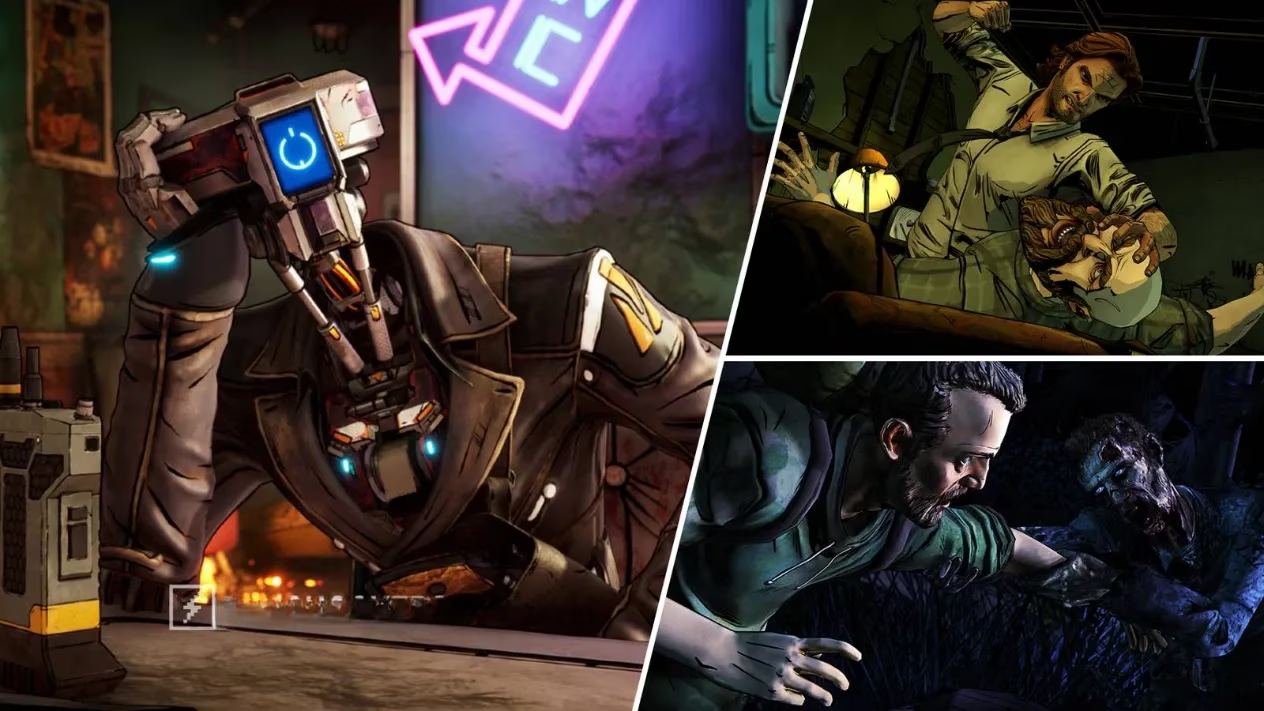
Pure, unadulterated fun. Tales From the Borderlands arrived when Telltale was at its peak, and it shows. It masterfully blended the studio's signature drama with the irreverent, chaotic humor of the Borderlands universe. Playing as the smooth-talking Rhys and the cunning Fiona, I was thrown into a hilarious and unpredictable caper on Pandora. The game didn't just reference the main series; it enriched it, introducing fantastic new characters like Loader Bot and fleshing out the world in meaningful ways. The rhythm of the storytelling, the soundtrack, the emotional beats—it all just clicked. It's a masterpiece of tone and a high-water mark for licensed adaptations.
4. The Walking Dead (Season One)
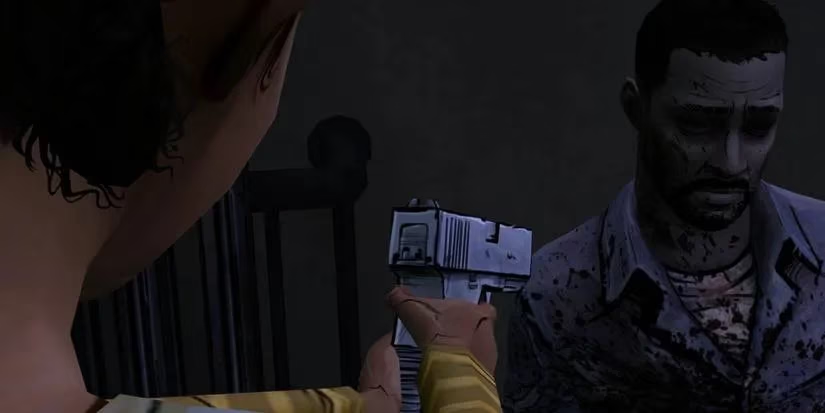
This is the one that changed everything, for Telltale and for me as a player. The Walking Dead: Season One wasn't just a game; it was an emotional event. Lee and Clementine's story is etched into my memory. Telltale proved here that player choice could be about forming deep emotional bonds, not just changing plot outcomes. The relationship I built with Clem, the impossible decisions at the farm or the drug store, and that utterly devastating finale... it redefined what I thought a video game narrative could achieve. It launched a phenomenon and remains a timeless, heartbreaking story about protection and humanity in a world that has lost its own.
3. Batman: The Enemy Within
If the first Batman game was a great reinvention, The Enemy Within was a phenomenal evolution. This sequel dove headfirst into the Bruce Wayne and John Doe (aka the Joker) relationship it had set up, and the results were breathtaking. This wasn't just another Batman vs. Joker story; it was a tragic tale of friendship, manipulation, and how Batman's actions could directly create his greatest enemy. My choices genuinely felt like they were sculpting the Joker's personality, leading to a 'Vigilante' or 'Villain' outcome. Coupled with a terrifyingly brutal take on the Riddler, this season was a tense, psychological thriller that stands as one of the most innovative Batman stories ever told in any medium. I still dream of that concluding trilogy chapter.
2. The Wolf Among Us
This game is sheer style and substance. The Wolf Among Us took the concept of fairy tales in the modern world and drenched it in a thick, neo-noir atmosphere. Playing as Bigby Wolf, the sheriff of a hidden community of Fables in New York, I was pulled into a gritty, murder-mystery filled with hard-boiled dialogue and moral ambiguity. The world-building was impeccable, turning Snow White into a cynical bureaucrat and the Crooked Man into a terrifying mob boss. The mystery was compelling, the characters were flawlessly written, and the moody, neon-drenched aesthetic was unforgettable. It's a self-contained masterpiece of detective fiction, and the long-awaited sequel is one of my most anticipated games, even in 2026.
1. Batman (The Telltale Series)
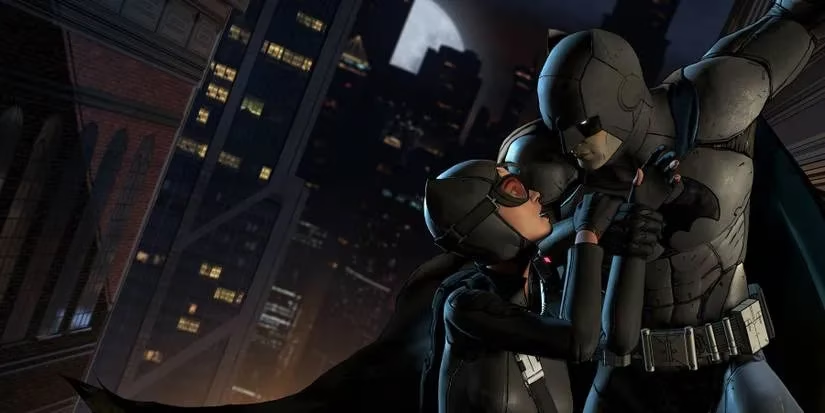
For me, this is Telltale's crowning achievement. The genius move was being allowed to completely reboot the mythology. This wasn't another story in the comics or a tie-in to the movies; it was Telltale's Batman. And what a vision it was. It flipped the script on everything: the Wayne family's legacy, the relationship with Catwoman, and most iconically, the origins of the Joker and Harley Quinn. Playing as both Bruce Wayne and Batman, where choices in the boardroom were as tense as choices in the alleyway, was revolutionary. It made me feel like I was truly shaping the legend of the Dark Knight from the ground up. The gameplay was varied, the twists were shocking, and it treated its audience with a maturity that respected the source material while boldly reimagining it. It represents the pinnacle of Telltale's interactive storytelling craft.
Reflecting on this list, it's clear that Telltale's legacy isn't just in the games themselves, but in the conversations they sparked. They created a space where story was king, where my voice felt heard in the narrative, and where licensed games could be bold, original, and deeply personal. While the studio's future has been uncertain, the impact of these adventures is permanent. They are the games I remember not for the scores I achieved, but for the characters I loved, the choices I regretted, and the stories that felt uniquely mine. In a medium constantly evolving, that's a magic trick worth celebrating.