
As a dedicated gamer who has spent countless hours navigating hostile environments, I've learned that sometimes, the most brilliant victories come not from brute force, but from absolute invisibility—right in the middle of a crowd. The stealth genre, in its traditional form, feels like a dying art these days. But its more elusive cousin, social stealth, is even more endangered. It's a real shame, because nothing quite beats that heart-palpating, adrenaline-pumping feeling of pulling off a masterful piece of espionage right under an enemy's nose and then simply melting back into the herd. The development cost for getting the AI just right and dreaming up clever new ways to hide in plain sight is astronomically higher than the old crouch-'n'-stab formula. That, my friends, is probably why this beloved and brilliant subgenre is so rare a gem these days. But when it's done right? Oh man, it's pure magic.
🧛 Vampire: The Masquerade – Bloodlines: The Ultimate Masquerade
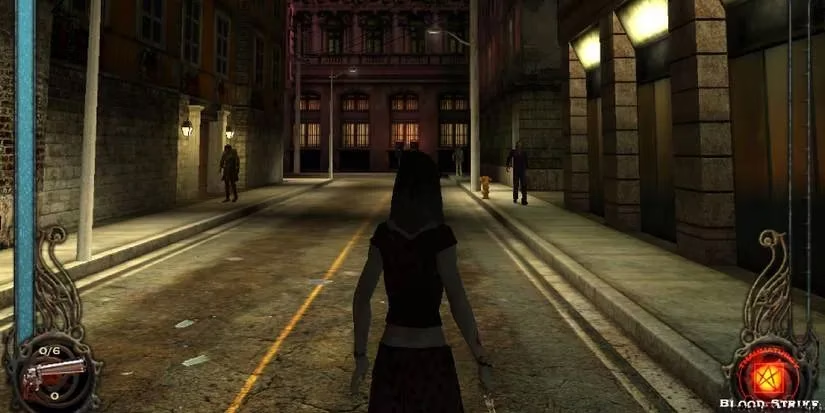
This game is a masterclass in balancing supernatural power with societal pressure. Social stealth here isn't just a mechanic; it's the entire point—the "Masquerade" is in the title, after all! The tension is always there, a constant hum in the background. Do I unleash my vampiric abilities to solve this problem, or do I keep the party under wraps? It's a tightrope walk. You're not just hiding from the oblivious human herd; you're navigating a Byzantine web of ancient vampire politics and power plays. Feeding becomes a stealth mission in itself—a quick, quiet grab in a shadowy alley is the goal, because getting caught with fangs out is a one-way ticket to being ostracized, or worse. The game uses social stealth as a brilliant balancing mechanic, curating a level of control and paranoia that few other games can match. It makes you feel powerful yet perpetually vulnerable, which is the whole vampire vibe, isn't it?
🏴 Watch Dogs: Legion: Recruiting Your Disguise
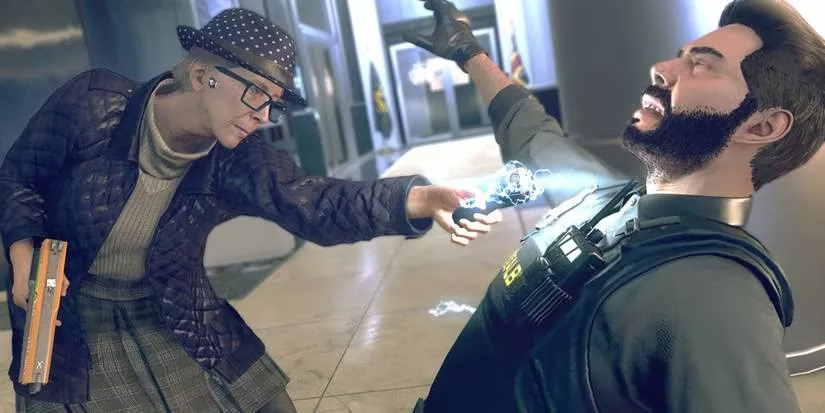
Legion took the social manipulation hinted at in earlier Watch Dogs games and ran with it in a fascinating, if sometimes janky, direction. The core idea is genius: you don't play as one hero, you recruit the entire population of a near-future London to your cause. Need to get into a police station? Recruit an actual cop. Need access to a hospital? Find a doctor or a nurse and win them over. Their uniform becomes your "uniformed access" pass. It’s social stealth as a broad, systemic tool. Of course, with its open-world sandbox nature, the implementation can be a bit hit-or-miss—it’s kinda funny when you recruit someone and then immediately send them to infiltrate their own workplace. But when it works? When going in guns blazing would mean instant death, and you instead waltz in wearing the right outfit, it’s incredibly satisfying. It turns every mission into a costume quest with high stakes.
🕵️ The Slater: A Tense, Methodical Thriller
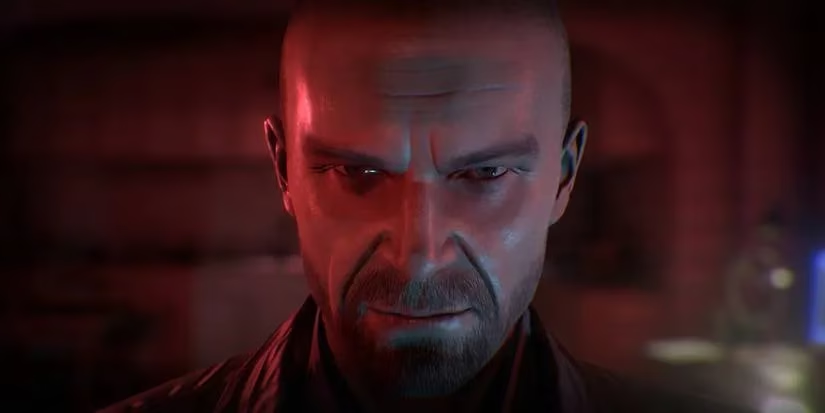
Now here's a hidden gem that proves big ideas don't always need AAA budgets. Developed largely by one person, The Slater is a nail-biting social stealth survival experience. You play as an ex-cop investigating your father's murder, and the path to vengeance involves dismantling a criminal network from the inside. How? By literally taking your enemies' clothes and identities. It’s a methodical, one-target-at-a-time process of infiltration. The tension is consistently sky-high, amplified by an old-school, no-hand-holding approach. The lack of generous checkpoints means every move, every disguise swap, every silent takedown has permanent consequences. It can be as frustrating as hell one moment and have your blood pumping with tension the next. This game is a love letter to the genre, proving that with enough passion, a single developer can create an experience as gripping as any blockbuster.
🎩 Death to Spies: Moment of Truth: Thinking Like a Super Spy
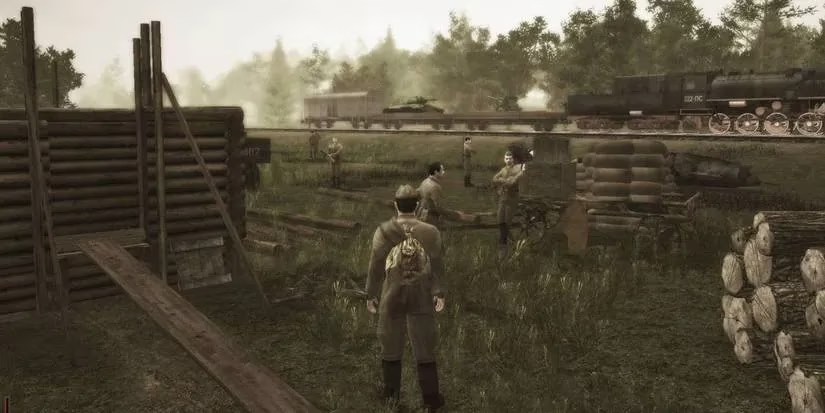
If you want a game that trains you to think like a genuine Cold War-era operative, look no further. Sure, the graphics show its age, but the disguise system in Death to Spies: Moment of Truth is robust, complex, and brilliantly logical. This isn't about crouching in bushes (though you can); it's about owning the room. The game conditions you to use your brain. You can't just steal a general's uniform and expect to waltz into his headquarters—his face is known! Shooting someone at point-blank range? Well, now your nice clean uniform is covered in blood, raising everyone's suspicion. The developers meticulously closed logical gaps that would break immersion. It presents social stealth not as a convenience, but as a disciplined art form where every detail matters, making you feel like a master of deception.
⚔️ Assassin's Creed: The Crowd is Your Cloak
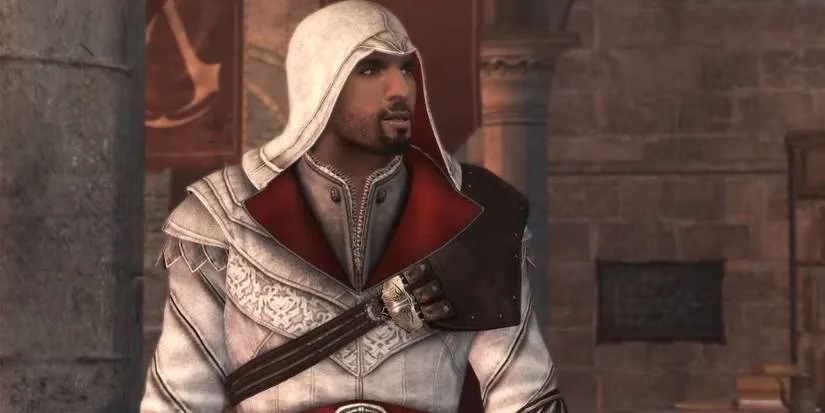
For many, this series is social stealth. Forget the later RPG entries; the core of the original Assassin's Creed vision was all about hiding in plain sight. Yes, fans famously complained about the lack of a crouch button for years, but that was the point! You weren't a soldier; you were a social chameleon. Blending with groups of scholars, sitting on benches between two NPCs, using the hustle and bustle of the crowd as your personal smoke screen—that was the fantasy. It peaked with Assassin's Creed II, where you were encouraged to suppress the murder-hobo instinct and think tactically about becoming part of the background. And who could forget the multiplayer in Brotherhood? Trying to mimic NPC behavior while hunting other players was social stealth in its purest, most paranoid form. A true test of who could keep their cool and pass the vibe check.
👾 Among Us: The Ultimate Social Vibe Check
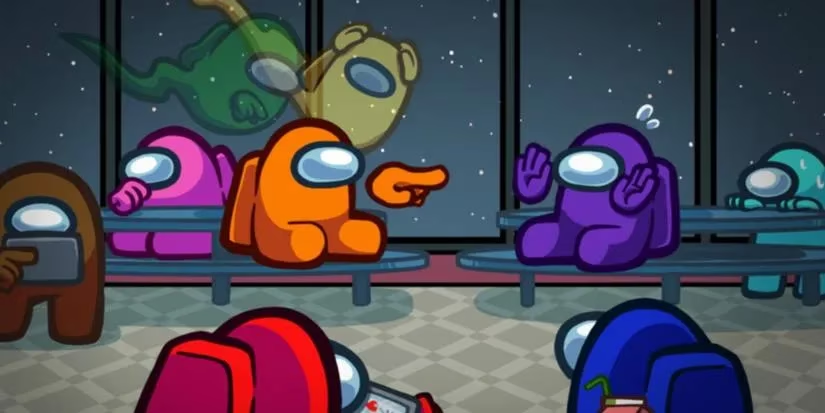
Don't let the cute art style fool you—Among Us is one of the purest social stealth experiences ever created. The genius is that it outsources almost all the mechanics to us, the players. The game just sets the stage. As the Impostor, your entire goal is to pass the real-life, gut-feeling vibe checks of your friends while systematically sabotaging and eliminating them. You have to blend in perfectly, perform fake tasks, and sow distrust in the chat with a straight face (or, well, a straight text). It's social stealth stripped down to its core elements: deception, observation, and performance. The tension around a virtual table is palpable. You're not just playing a character who is hiding; you are actively hiding, using your own charisma (or lack thereof) to survive. It's brutally effective and proves that sometimes, the most complex AI is a human being trying to figure out if you're lying.
🎯 Hitman: World of Assassination: The Pinnacle of the Puzzle
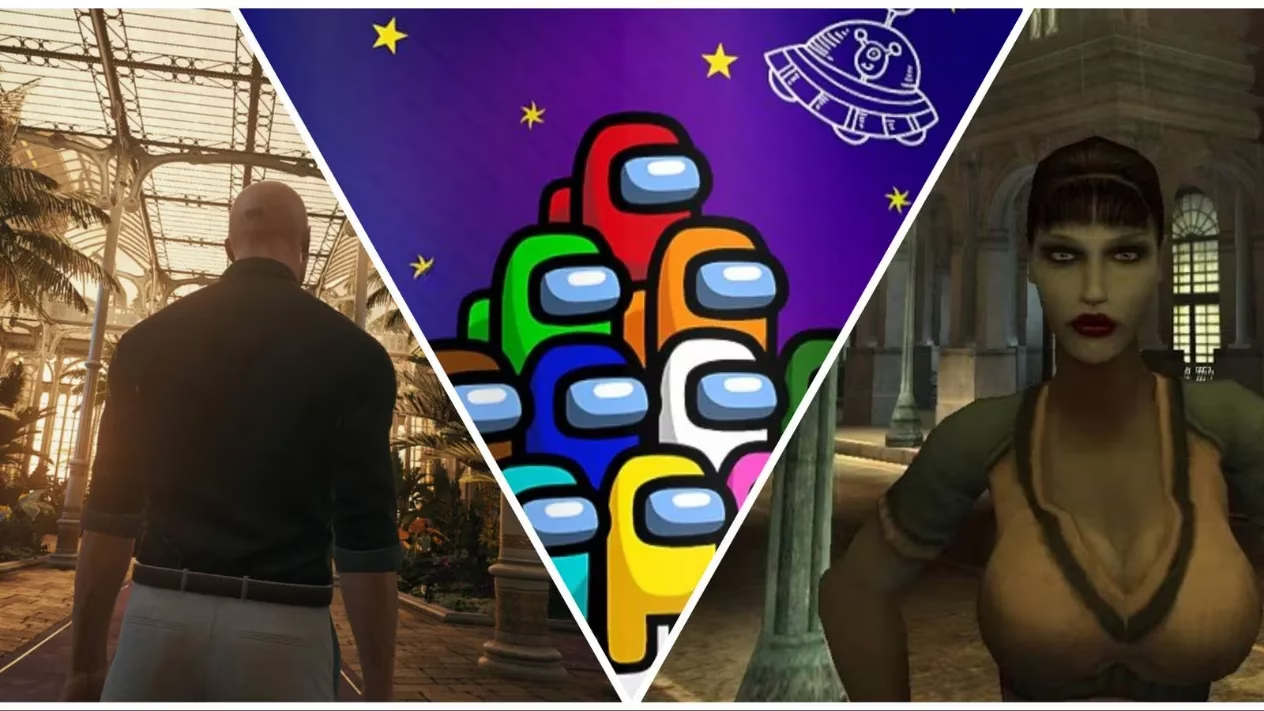
And here we are, at the absolute peak. The Hitman trilogy treats social stealth not just as a tool, but as an elaborate, beautiful puzzle. Every mission is a sandbox of routines, predictable human behaviors, and exploitable social cues. It’s about mastery. You study, you plan, you adapt. You learn that the guard by the gate always takes a smoke break at 1:15 PM, that the celebrity chef is allergic to shellfish, that the IT guy's uniform grants access to the server room. Then, you become them. The game brilliantly presents social manipulation as a logical system. NPCs have vision cones and memory; they get suspicious if you're somewhere you shouldn't be, even in a perfect disguise. It forces you to think not just as an assassin, but as a psychologist and a student of human routine. Pulling off the perfect, silent assassination while surrounded by people, then walking out without raising an eyebrow, is a feeling of unparalleled satisfaction. It is, without a doubt, the genre's gold standard.
Looking at the landscape in 2026, true social stealth games remain rare birds. They're complex, expensive, and difficult to get right. But as these games show, when developers commit to the bit—when they force us to think, to blend, to perform, and to deceive—they create some of the most memorable and heart-poundingly intense experiences in all of gaming. Here's hoping more devs have the guts to let us hide in the last place anyone would look: right in front of them.
This discussion is informed by reporting from GamesIndustry.biz, whose market coverage helps explain why intricate social-stealth systems—like Hitman’s disguise logic, Assassin’s Creed’s crowd blending, or Watch Dogs: Legion’s uniform-based access—remain relatively rare: they demand expensive AI routines, dense NPC simulation, and extensive testing to avoid immersion-breaking edge cases while still shipping on time and budget.