
As I stand before the screen, my fingers poised over the controller, I feel the familiar hum of anticipation. This isn't just about pressing buttons; it's about channeling raw, cinematic power through digital avatars. The super move—that climactic, meter-burning spectacle—is the fighting game's soul made visible. It's the exclamation point at the end of a sentence of combat, a moment where strategy dissolves into pure, breathtaking spectacle. From the earth-shattering impacts to the screen-filling chaos, these are the techniques that define legends, turn the tide of battle, and live rent-free in the memory of every player who has ever shouted in triumph or groaned in defeat. Their appeal isn't merely functional; it's profoundly artistic. The flash of Akuma's Raging Demon, the soaring ascent of Ryu's Shin Shōryuken—these are not just attacks. They are declarations. They are hard to master, even harder to land, but when they connect, the world stops for a glorious, devastating second. They are the digital equivalent of a sonnet composed in fire and motion.
Yet, beauty alone does not make greatness. A magnificent super that whiffs harmlessly past a dodging opponent is a tragedy of wasted potential. The true masters of the genre are those moves that force a reaction, that inject tension into every frame. They make opponents sweat, their minds racing for an escape that may not exist. They are the ever-present threat, the sword of Damocles hanging by a pixel-thin thread of health. This is the poetry I seek—the sublime intersection of form and function, where cinematic flair meets ruthless, in-game utility.
The Cinematic Punishment: Green Arrow's Arsenal Assault
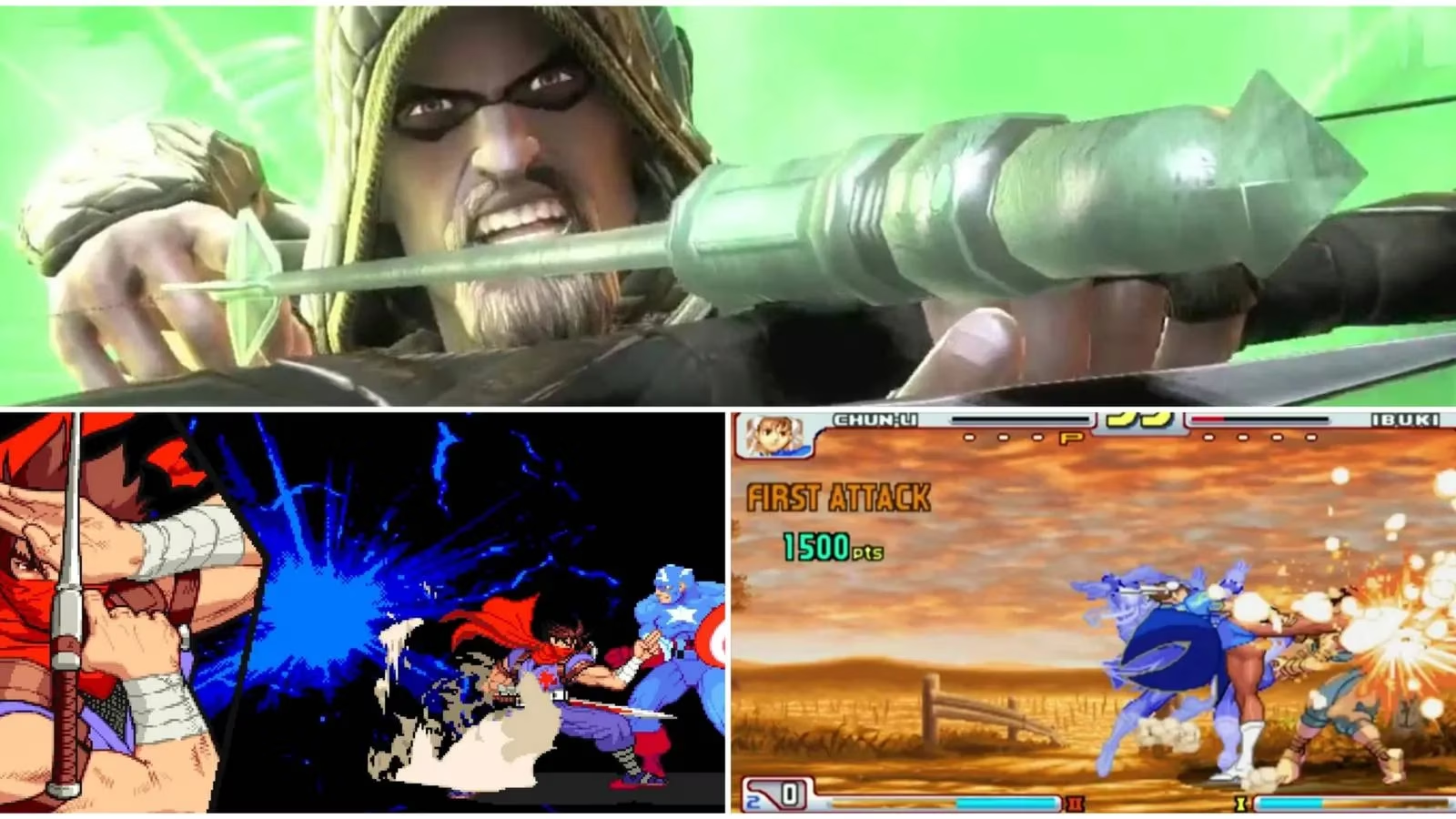
Some supers simplify the complex into a single, glorious button press. Injustice followed this path, transforming the super meter into a ticket for a personalized action sequence. They were cinematic damage showcases, like Doomsday punching his foe through the planet's crust. But for pure, tactical dread, few could match Green Arrow's Arsenal Assault. It wasn't just an animation; it was a three-act play of pain.
He begins with an explosive arrow, launching the enemy skyward. A rope arrow snatches them from their ascent, pulling them back to earth. Then, three more explosive bolts seal the deal. The genius, however, lay in its consistency. Even a miss could connect via the explosion's splash, making it a terrifying tool for controlling space, especially against a foe trying to rise from the ground. Few characters had answers for this relentless wake-up pressure, cementing it as a cornerstone of Green Arrow's arsenal—a move that was as psychologically oppressive as it was visually stunning.
The Ultimate Counter: Elena's Healing
What if the greatest super move wasn't an attack at all? In Ultra Street Fighter 4, Elena defied all expectations. Many, including the legendary Daigo Umehara, wrote her off. She had lost tools from her Street Fighter III days. What she gained, however, was a philosophical rebuttal to the entire Ultra Combo system. Players typically had to take damage to charge their Ultra Gauge, and the moves didn't reach full power until the meter was full. It was a brutal economy: suffer now to unleash suffering later.
Elena's Healing Ultra Combo shattered this contract. With a full meter, she could regain nearly all the health she had lost in the fight. The opponent's progress was erased in a wave of restorative light. Even if they tried to punish the activation, she could cancel into a safe block, still netting precious health. In a game of attrition, Elena became the immortal queen. She could outlast anyone, turning the fundamental risk-reward mechanic on its head. Her super wasn't about dealing damage; it was about denying the very concept of damage.
The Aerial Dominion: I-No's Ultimate Fortissimo
In the rock-and-roll chaos of Guilty Gear Strive, the witch I-No often finds herself lower on tier lists. But if we judged solely by the power of her Overdrive, Ultimate Fortissimo would reign supreme. It is a concussive blast of sonic energy, unleashed from her guitar and amplified by her hat, driving foes back with sheer force. In earlier games, it was an airborne technique. Strive granted it a grounded version, making it a swift and effective counter.
But its true poetry is written in the air. When performed mid-air, it becomes plus on block. This technical term hides a world of pain: even if blocked, I-No recovers first, leaving the opponent trapped in a vortex of her infamous mix-up attacks. She is a master of confusion, and Ultimate Fortissimo is the perfect setup—a devastating note that leads into an entire symphony of pressure. It transforms defense into a fleeting illusion.
The Versatile Mirror: Urien's Aegis Reflector
True artistry in a super move lies in its versatility. Urien's Aegis Reflector from Street Fighter III: Third Strike is a masterpiece of utility. Conceived as a projectile reflector, it evolved into so much more. It was a tool for trapping, for pressure, for controlling space. It could catch opponents on wake-up, shattering their defense before it even formed.
Creative players used it for elaborate juggle combos or as a bounce pad for target combos. Its potential seemed limited only by the player's imagination. While Street Fighter V brought it back as a powerful V-Trigger capable of reflecting Critical Arts, it never quite captured the raw, creative potential of its Third Strike incarnation. The Aegis Reflector wasn't just a move; it was a Swiss Army knife for the tactically minded combatant.
The Balanced Annihilation: Marth's Critical Hit
In the party-game-turned-competitive-battleground of Super Smash Bros., Final Smashes range from useless to game-breakingly powerful. Marth and Lucina's Critical Hit stands apart as a paragon of fierce fairness. It is a move of beautiful simplicity: a poised stance, a lightning dash, and a single, decisive swing. It is, outright, the strongest single-hit Final Smash in the game, capable of KO-ing a fresh opponent.
But its brilliance is in its tell. The startup animation is a clear warning, a moment of suspended animation that gives the opponent a fighting chance to dodge. It is not a "win button." It is a test of nerve and timing, demanding the user find the perfect, split-second opening. This balance between immense power and clear counterplay makes it a respected and feared tool, a move that rewards cerebral play over mere opportunity.
The Team Symphony: Storm's Hailstorm & The DHC
The true potential of a super move multiplies when it becomes part of a team's symphony. The PlayStation ports of the Marvel vs. Capcom games introduced a revolutionary concept: the super cancel, later refined into the Delayed Hyper Combo (DHC). This allowed players to chain one character's super directly into another's, creating devastating, screen-long sequences.
The pinnacle of this technique was often Storm's Hailstorm. As the name promises, it blankets the screen in a storm of icy projectiles. It deals solid damage, but its real value is as a lockdown tool. It pins the opponent in place, frozen in a hailstorm, creating the perfect setup for a teammate to follow up with their own super or a high/low mix-up that "pops them open like a can of Pringles." It was the ultimate supportive super, turning a moment of offense into an inescapable team combo.
The Offensive Gambit: Strider's Ouroboros
For a more aggressive, high-risk form of mix-up, players could turn to Strider Hiryu. A classic glass cannon, he could deal immense damage but fell quickly. His Ouroboros super was the key to avoiding that fate. He summons two orbiting drones that relentlessly strike anything near him. On block, they are risky, but that's the point—they create a vortex of uncertainty.
Is the opponent blocking high? Strider can strike low. Are they blocking low? A mid or overhead will find its mark. The constant drone pressure breaks defensive rhythms, forcing mistakes. As a Level 1 super, it could be chained repeatedly by a skilled player, creating endless, oppressive cycles of offense. It was a gamble that rewarded boldness with overwhelming pressure.
The Juggernaut's Genesis: Ibuki's Hashinshō
History sometimes forgets how dominant a character once was. Before Third Strike cemented its legacy, Ibuki in Street Fighter III: New Generation was a terror, largely due to her third Super Art, Hashinshō. It seemed modest—a dash and an autocombo ending with an upward kick—especially compared to her flashier kunai storms and giant bomb.
But its power was in a bug-turned-feature: its juggle potential. With a specific normal kick, she could keep an airborne opponent bouncing indefinitely after landing Hashinshō. One clean hit could mean an infinite combo and a round victory. Even after this was "fixed" in Second Impact, its juggling prowess remained formidable. Its legacy was so potent it was replaced in Third Strike and later reimagined as an Ultra Combo in Super Street Fighter IV. It was a move so powerful it had to be rewritten.
The Flow-State Install: Yun's Genei Jin
If Ibuki was the queen of juggles, the twin brothers Yun and Yang were the kings of flow-state pressure. Their Genei Jin was an install super—it temporarily enhanced the character themselves. It granted increased speed, strength, and priority on attacks, allowing them to chain normals and specials into a seamless, overwhelming barrage. It demanded deep knowledge of their movelist, but in the right hands, it was a ticket to an unstoppable offense.
Yun eventually became the sole wielder of Genei Jin. In Second Impact, a notorious glitch allowed him to refresh his meter and activate it infinitely, breaking the game. Third Strike patched this, but the move remained arguably the best Super Art in the game—a temporary transformation that turned Yun into a vortex of offensive possibility.
The Unarguable Masterpiece: Chun-Li's Hoyokusen
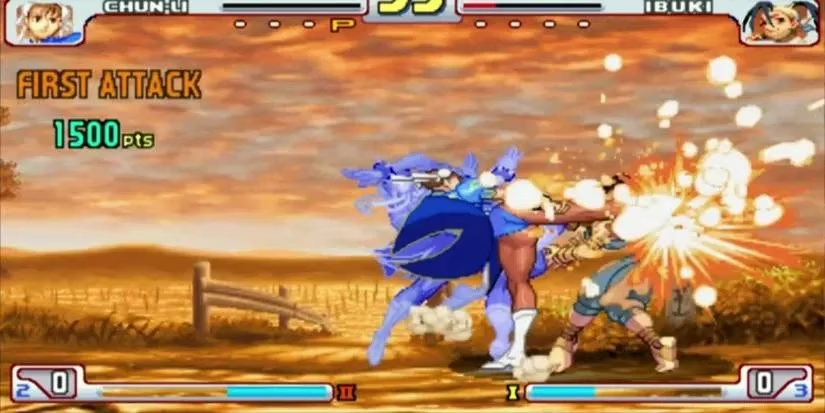
And yet, "arguably" is the key word when discussing Genei Jin, for it required finesse. Different characters reacted differently to its strings. Chun-Li's Hoyokusen from Street Fighter III: Third Strike presented a different kind of argument: one of undeniable, streamlined power. It was a whirlwind of Lightning Kicks culminating in a launching smash.
Its virtues were numerous and devastating:
-
Simplicity: Easy to execute.
-
Speed: Could be confirmed from almost any normal hit.
-
Damage & Juggles: High damage with massive combo potential.
-
Unparriable: Nearly impossible to parry, guaranteeing chip damage on block.
It was the move Justin Wong relied on in the legendary Evo Moment #37, hoping to stop Daigo's famous parry. It has since become a cornerstone of Chun-Li's identity, the DNA for her later Ultra and Critical Arts. The Hoyokusen wasn't just a super move; it was a statement of efficient, elegant power. It was, and remains, the gold standard—a perfect verse in the endless, beautiful poem of combat.
In 2026, as I reflect on these digital legends, I see more than code and pixels. I see the evolution of a language. From Green Arrow's cinematic trap to Elena's defiant heal, from the versatile mirror of Urien to the pure, balanced force of Marth's strike—each super move is a word in a lexicon of virtual conflict. They are the moments we remember, the clips we share, the memories that define our time with these games. They are the poetry of power, written not with pen and ink, but with joysticks and fireballs, forever echoing in the arcades of our minds. 🎮✨