
I still remember the first time I slipped into the ventilation shaft\u2014not as a little bean on a flat screen, but as a breathing, shuffling figure in the cold metal ducts of a 3D Skeld. It was 2022 when the trailer dropped, teasing a glimpse of an Impostor's hidden world. Now, four years later in 2026, that vertical heat-ray of possibility has become my daily reality. The shift from a top-down map to a first-person view has not just changed the game; it has rewired how I trust, how I lie, and how I see.
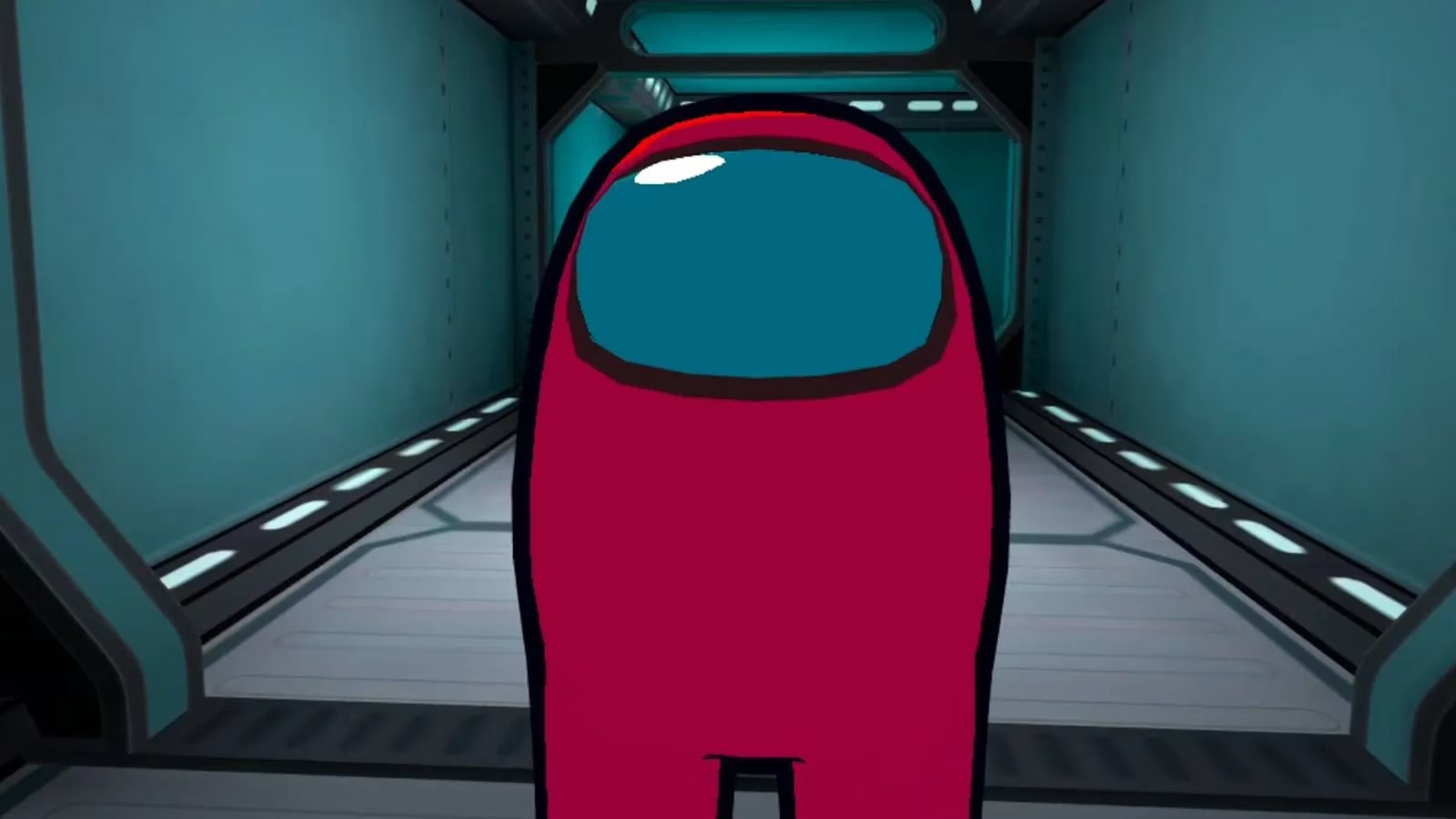
The original Among Us gave birth to the verbs of a generation\u2014\u201cventing\u201d and \u201csus\u201d were born from frantic text chats and blob-like avatars darting across a 2D blueprint. But how do you capture that same paranoid spark when every player sees through their own eyes, their hands gesturing in real space? That was the question that haunted me when Innersloth first announced the VR mode. The answer, I’ve discovered, lies in the vents themselves.
Peeking Through the Grid
In the flatworld, venting was a quick, clean teleport: you hopped in, a screen flashed, you hopped out. The new gameplay trailer from 2022 hinted at more, and it delivered. As an Impostor in 2026, I crouch inside the shaft, and the world shrinks to a narrow slice of corridor visible through the grate. I press my virtual face against the slotted metal, and I see\u2014truly see\u2014the boots of a passing crewmate, the flicker of their flashlight, the hesitant pause when they hear a distant hum.
The immersive first-person view doesn’t just show me the immediate area; it forces me to interpret the tiniest cues. Is that shadow moving? Did I hear a faint breath? I can peek indefinitely, my heartbeat syncing with the ambient hum of the ship. There is no minimap here, no god’s-eye reassurance. Only the slotted bars and the terrifying thrill of deciding when to emerge. And because I can literally duck behind corners and lean into doorframes after my escape, the game has become a dance of spatial deception. How often have I held my breath while a crewmate stared straight at the vent\u2014and saw nothing but a static cover?
Speaking with Hands, Not Words
Before VR, communication was all about emergency meetings and sterile text logs. But now? We have hands. So many hands. The trailer once showed finger-pointing and high-fives, and in the years since, these gestures have evolved into a full-blown sign language of suspicion. I can wave a friend over, tap my wrist as if checking a non-existent watch, or dramatize a shrug that says \u201cIt wasn’t me\u201d far more convincingly than any typed defense ever could.
Yet this richness is a double-edged blade. When I lace my fingers together and crack my knuckles while staring at the body you just reported, what does that say? The old word \u201csus\u201d now lives in the subtle way I don’t high-five you back, or in how my gloved hand hesitates for a split second before pointing toward Electrical. Crewmates have to read these micro-expressions, these virtual tics that betray nerves. As an Impostor, I’ve learned to control my hands as much as my alibi. Isn’t it strange that the most honest part of me is now the easiest to fake?
The Architecture of Paranoia
Ducking behind corners has reshaped the map itself. In the original, you could be spotted from across the room at a glance. Now, a well-crouched Impostor can hug the wall of MedBay, invisible to a crewmate scanning at the station unless they turn their head exactly right. I’ve hidden mere inches behind someone, my digital breath fogging the inside of my helmet, as they completed their tasks in blissful ignorance. The ship isn’t just a 2D space anymore; it’s a volume, a maze of blind spots where danger can crouch.
This shift has birthed new rituals. Crewmates now walk in pairs not just for safety, but for full 360\u00b0 coverage\u2014one watching front, one scanning behind. We’ve developed a pat-down of common hiding spots, a rhythmic knocking on doors before entry that echoes through the vents. And yet, the Impostor’s perspective from within those metal intestines remains the ultimate cheat. I can sit in the vent and watch two crewmates accuse each other, my virtual lips twitching into a smile they will never see.
Have New Phrases Been Born?
\u201cVenting\u201d and \u201csus\u201d entered the lexicon in 2020. But what of the VR era? After four years of headset-based betrayal, I’ve watched new slang crawl out of the ducts. \u201cGrate-gazing\u201d is what we call an Impostor who peeks too long, paralyzed by the risk. \u201cGhost hand\u201d describes that eerie moment when a crewmate’s hand twitches near a report button but doesn’t press\u2014too scared to call a meeting alone. Some players whisper \u201cvisor fog\u201d to mean a lie so obvious you can practically see it on their helmet. Will these words stick the way their forebears did? I don’t know. But I’ve already said \u201cYou were grate-gazing, I saw you!\u201d in a lobby full of laughter and accusations.
What truly captivates me is how the game has become less about logical deduction and more about visceral intuition. When you stand before a vent, you can almost feel the warmth of a body hiding just beneath. When you shake your head in denial while your finger accidentally points at the corpse, physics betrays you. Among Us VR hasn’t just added a dimension; it’s added a nervous system.
The trailer from 2022 felt like a promise of immersion. Now, in 2026, that promise is a living, breathing metagame. I am no longer playing a detective; I am a body with a secret, moving through a spaceship that feels real enough to smell the ozone and hear the creak of old metal. And every time I survive a round as an Impostor, I pause inside the nearest vent, peeking through the grate, and wonder: if you looked through that slot right now, would you see just an empty grille\u2014or a glint of helmet glass, staring back?